

Article by Devin McPhillips
What defines the boundary between weighted and unweighted kebari? They may share a prominent hackle, but they are usually fished with different techniques. Weighted kebari support some version of tight-line nymphing, and unweighted kebari reward more traditional tenkara presentations. As I work to improve my technique, this boundary seems more important but less clear.
The simplest definition of an unweighted kebari might be the lack of a tungsten bead head. Another simple definition might be the lack of the telltale “clunk” marking the beginning and end of a normal cast. A third definition might focus on the drift: an unweighted kebari rides in the turbulent eddies, and a weighted kebari tracks a specific depth. None of these definitions seem sufficient. I’ve always been tempted to sink my “unweighted” kebari a little deeper with wire wraps or a heavier hook, and I’ve experimented with “ultralight” nymph rigs that cast fairly well.


Inspired by Rob Worthing’s book called Demon’s Game: The Oni School of Tenkara Fly Fishing, I’ve been practicing my “unweighted” kebari presentations. I started fishing sighter flies, tied with bright materials for human visibility. Watching my kebari throughout the drift, I’m beginning to see the importance of small differences in kebari design. I thought it would be helpful to quantify some differences, so I bought a scale and started weighing my flies. The results helped me refine my definitions of weighted and unweighted kebari and emphasized the importance of hook type and dressing when selecting patterns for unweighted presentations.

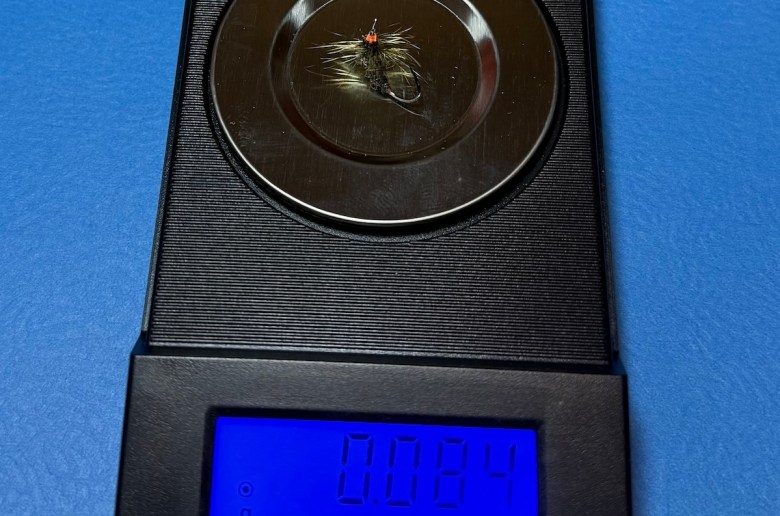
To start with the extremes: the heaviest fly I tie regularly is a #12 two-bit stone, which weighs about 70 centigrams and has both a 4 mm and a 2.8 mm tungsten bead; the lightest fly is a #16 stiff hackle emerger, which weighs less than 3 centigrams.


By weight, the boundary between weighted and unweighted kebari seems to be near 10 centigrams, which is the weight of the heaviest “unweighted” kebari in my box (#12 Copper John sakasa). The smallest weighted nymph I tie regularly (#18 blowtorch with a 2.4 mm bead) weighs 13 centigrams.
It is interesting to note that 5 meters of #3 Nissin level line weighs about 70 centigrams. A classic kebari, cast with a 4 meter rod, weighs about 10% of the line. I can barely discern the presence of the fly when casting this rig. I definitely notice a single 13 centigram blowtorch when casting a similar setup, but the blowtorch is less onerous if I use a #4.5 level line weighing around 100 centigrams. There may be an important transition for casting beyond about 10% of the line weight.


The boundary between unweighted kebari and western dry flies seems to be better defined by dressing than by weight. For example, the set of kebari that I tie most often ranges from 4 to 9 centigrams, and I always fish these below the surface film. But I have store-bought #12 Adams dry flies that also weigh 9 centigrams. Their weight seems to be in the abundant hackle and tail, which help to hold the Adams above the surface.
The behavior of kebari within the 4 to 9 centigrams range varies dramatically. For example, I often use a DRAGONtail standard-wire stimi hook (ML601, #14) for a pheasant-tail flymph that sinks like a stone at 9 centigrams. It works great for deeper, faster water but can drag on the bottom in shallower riffles. In contrast, an Oxford wool kebari, tied on a #12 Fulling Mill FM0565 nymph hook with stiffer hackle, weighs 8 centigrams but easily rides in the upper 6 inches.


I have only one true Oni kebari, which was included as a gift when I ordered my Type-1 rod. It appears to be a #12 or #10 hook and weighs 6 centigrams. My usual approximations are tied on a #12 DRAGONtail ML101 dry fly hook. The simplest version weighs barely 4 centigrams. More often, I add Copper John style wraps of small-size wire under the dubbing the increase the weight to 6 centigrams. On these kebari, the thread-wrapped hackle stands upright, but the body is slim, and the design seems particularly suited to take advantage of turbulent eddies to either float or sink. I can sometimes sink my 6 centigram version in a subtle downwelling current but rarely the 4 centigram version. It is easy enough to hold either within inches of the surface.


With careful attention to stream currents and kebari dressing, the skilled angler may be able to sink an unweighted kebari to briefly mimic tightline nymphing presentations. I lack the confidence to reliably sink a 6 centigram unweighted kebari below the upper third of the water column, and so I still carry some weighted kebari, usually weighing between 20 and 50 centigrams. I usually want a different rod to cast these kebari, too
On a recent trip to a bigger river, weighted kebari caught the bigger fish. But my presentations with unweighted kebari were also successful. As I continue to practice with unweighted kebari, I plan to focus on just a few patterns between 6 and 9 centigrams. Small differences have important effects, and I want consistent responses from the kebari in order to improve my technique.

Devin McPhillips and his son, Owen, are tenkara anglers and fly tiers in Southern California.
Do you have a story to tell? A photo to share? A fly recipe that’s too good to keep secret? If you would like to contribute content to Tenkara Angler, click HERE for more details.